
Thailand Updates DTV Visa Rules: New Application Restrictions and Criminal Record Checks from 31 August 2026
Thailand’s Destination Thailand Visa (DTV) is becoming subject to stricter application requirements.
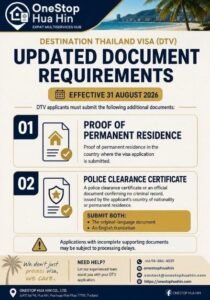
From 31 August 2026, applicants will face two important additional conditions when applying for a DTV: they must have a qualifying connection to the country where they submit their application, and they must provide a criminal record clearance certificate.
The changes are particularly relevant for foreigners who previously considered traveling to a neighbouring country simply to submit a Thai visa application.
What is changing for DTV applicants?
The new measures introduce two significant checks.
1. You must apply in your country of nationality or permanent residence
Under the updated requirements, a DTV application must be submitted in a country where the applicant is either:
- A citizen or national; or
- A permanent resident.
This means that simply being physically present in another country is no longer sufficient.
For example, a British citizen who is traveling through Laos would not automatically be able to apply for a DTV at a Thai embassy in Vientiane. The applicant would need to be a Lao national or hold permanent residence in Laos.
The same principle applies to applications submitted through other Thai embassies and consulates.
The Royal Thai Consulate-General in Savannakhet has specifically confirmed that, from 31 August 2026, DTV applicants applying there must be Lao nationals or permanent residents of Laos. (Ambasciata Thailand Savannakhet)
2. A criminal record certificate will be required
Applicants will also need to submit a police clearance certificate or criminal record certificate.
The certificate can be issued by:
- The applicant’s country of nationality; or
- The country where the applicant is applying, where applicable.
Applicants should also pay close attention to language requirements. Documents issued in a language other than Thai or English may need to be translated and properly certified, depending on the responsible Thai embassy or consulate.
The exact validity period and format of the police certificate can differ between missions. For example, the Royal Thai Embassy in London specifies that its certificate must be issued within six months of the application date. (สถานเอกอัครราชทูต ณ กรุงลอนดอน)
This is an important point: do not obtain a police certificate too early without first checking the requirements of the embassy responsible for your application.
Can you still apply for a DTV?
Yes.
The new measures do not cancel the Destination Thailand Visa.
The DTV remains Thailand’s long-stay multiple-entry visa designed for eligible categories including remote workers and freelancers, as well as people participating in qualifying Thai activities and eligible family members.
The official Thai e-Visa platform continues to list the DTV as a current visa category for “Work-cation and Thai soft power related activities.” (ไทยวีซ่าอิเล็กทรอนิกส์)
What has changed is where you can apply and what additional documentation you must provide.
What does this mean for people already in Thailand?
This is particularly important for foreigners currently living in Thailand who were planning to leave the country and apply for a DTV from a nearby country.
In the past, applying from a neighbouring country could sometimes be considered a practical option, depending on that embassy’s rules.
From 31 August 2026, simply traveling to another country for the purpose of submitting a DTV application will generally no longer be enough.
Applicants should instead determine which Thai embassy or consulate is responsible for their application based on their nationality or permanent residence.
What about applications submitted before 31 August?
Applicants who are already preparing a DTV application should not leave everything until the last moment.
Where an application has already been submitted and the visa fee has been fully paid before the new rules take effect, the relevant mission may continue processing it under the previous requirements, according to the transition arrangements announced with the new measures.
However, applicants approaching the deadline should make sure that:
- The application has actually been submitted;
- The visa fee has been successfully paid;
- The required documents have been uploaded;
- The application is not still incomplete or waiting for essential information.
Simply creating an e-Visa application account or starting an application should not be assumed to protect an applicant from the new requirements.
The DTV is still a five-year visa — but preparation matters more
The Destination Thailand Visa remains attractive because of its long validity and multiple-entry structure.
However, applicants should now approach the process more carefully.
Before applying, check:
1. Where are you legally entitled to apply?
Confirm that the Thai embassy or consulate accepts applications from nationals or permanent residents of your country of application.
2. Do you need proof of permanent residence?
If you are applying outside your country of nationality, be prepared to demonstrate your permanent-resident status where required.
3. Where will you obtain your criminal record certificate?
Check whether the relevant mission accepts a certificate from your nationality country, country of residence, or both.
4. Does the certificate need translation or certification?
Documents not issued in English or Thai may require additional formalities.
5. Is the certificate still valid?
Do not assume that a police clearance certificate obtained several months ago will automatically be accepted.
6. Are there additional requirements from the embassy?
Thai diplomatic missions retain discretion to request additional documents or an interview. The official Thai e-Visa system also states that submitting an application does not guarantee approval and that visa fees are non-refundable. (ไทยวีซ่าอิเล็กทรอนิกส์)
A significant change for “visa shopping”
One of the practical consequences of the new policy is that applicants will have fewer opportunities to choose a Thai embassy simply because it is geographically convenient or perceived to have an easier application process.
This represents a shift toward a more clearly defined country-of-application system.
For DTV applicants, this makes preparation particularly important. Choosing the wrong embassy could result in an application being refused or requiring additional documentation.
What should prospective DTV applicants do now?
If you are considering a DTV, it is advisable to start preparing before making travel plans.
A sensible approach is to:
1. Identify the Thai embassy or consulate responsible for your application.
2. Confirm whether you qualify as a national or permanent resident of that country.
3. Check the latest DTV document checklist.
4. Begin the criminal-record clearance process if required.
5. Arrange translations and certifications where necessary.
6. Prepare the financial and supporting documents required for your specific DTV category.
7. Submit the application only after confirming that the requirements are current.
The official Thai e-Visa website should be treated as the primary reference point, together with the specific Thai embassy or consulate handling the application. (ไทยวีซ่าอิเล็กทรอนิกส์)
What this means for foreigners living in Hua Hin
For expats currently living in Hua Hin who are considering changing their immigration status or obtaining a DTV, these changes are worth understanding before making any plans to leave Thailand.
A DTV application is not simply a matter of finding the nearest Thai embassy outside Thailand. From 31 August 2026, the applicant’s nationality or permanent-residence status in the country of application becomes a critical part of the process.
At OneStop Hua Hin, we recommend checking your individual circumstances before making travel arrangements or paying a visa fee.
Visa regulations and embassy procedures can change, and individual missions may request additional documentation depending on the applicant and the circumstances of the application.
Need help with your Thailand visa?
If you are considering a Destination Thailand Visa (DTV) or another Thai visa option, OneStop Hua Hin can help you understand the current requirements, prepare your documentation and identify the appropriate application route.
Contact OneStop Hua Hin before making your visa plans — proper preparation can save time, unnecessary travel and avoidable costs.
