
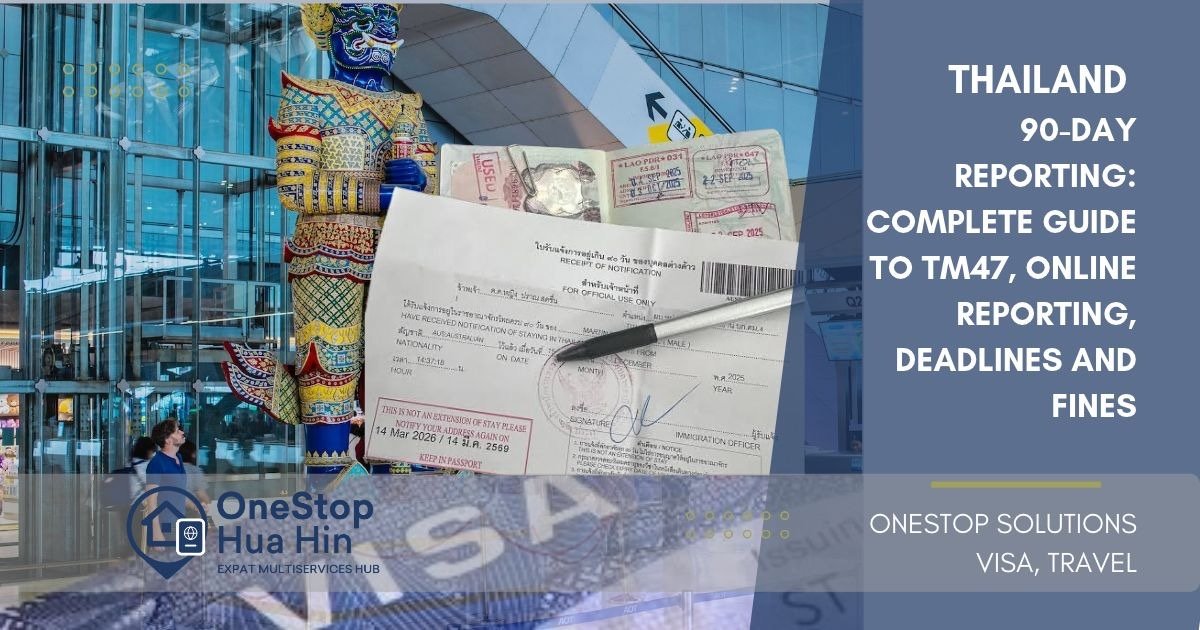
Thailand 90-Day Reporting: Complete Guide to TM47, Online Reporting, Deadlines and Fines (2026)
Living in Thailand long-term? Understanding the 90-day reporting requirement is essential. Learn when to report, how to submit your TM47 form online, what documents you need and what happens if you miss your deadline.
Thailand is home to a growing international community. Thousands of foreigners choose to stay in the country for retirement, family life, business, education or other long-term arrangements.
For many of them, one immigration requirement becomes part of everyday life: 90-day reporting.
Whether you hold a Retirement Visa, Marriage Visa, Non-Immigrant Visa, Education Visa or another qualifying permission to stay, you may be required to notify Thai Immigration of your current residential address every 90 days.
Although the procedure is relatively straightforward, it can become confusing, particularly for people who are completing their first report, have recently changed accommodation, have received a new passport or are unfamiliar with Thailand’s online immigration system.
Missing the reporting deadline can also result in a fine and unnecessary complications.
At OneStop Hua Hin, we regularly assist foreigners with immigration procedures and understand that keeping track of different reporting dates and documentation requirements can be challenging.
In this guide, we explain how Thailand’s 90-day reporting system works, the different ways to complete your notification and what you should do to avoid problems.
1. What Is 90-Day Reporting in Thailand?
90-day reporting is an immigration requirement under Section 37(5) of Thailand’s Immigration Act B.E. 2522 (1979).
Foreign nationals who are permitted to stay temporarily in Thailand and remain in the country for more than 90 consecutive days must notify Immigration of their current residential address.
The official notification is made using Form TM47, commonly known as the 90-day report.
The purpose of this procedure is to keep Thai Immigration informed of the residential location of foreign nationals staying in the Kingdom for extended periods.
It is important to understand that 90-day reporting is an address notification requirement, not a new visa application.
It does not replace your visa, extend your permission to stay or give you additional immigration rights.
Who needs to complete 90-day reporting?
The requirement generally applies to foreigners who:
- Hold a valid permission to stay in Thailand;
- Remain in the country for more than 90 consecutive days;
- Are required to report their residential address under the Immigration Act.
This commonly includes:
- Foreign retirees holding Non-Immigrant O or O-A visas;
- Foreign nationals staying in Thailand on Marriage Visa arrangements;
- Holders of Non-Immigrant B visas;
- Foreign students holding Education Visas;
- Holders of Long-Term Resident (LTR) visas;
- Other foreign nationals with qualifying long-term permission to stay.
The exact immigration arrangements depend on the individual’s status and applicable regulations.
Important: The requirement is based on the length of your continuous stay in Thailand, not simply on the type of visa printed in your passport.
2. When Is Your Thailand 90-Day Report Due?
Understanding the reporting date is one of the most important parts of the process.
Your first 90-day reporting period generally begins from your most recent entry into Thailand.
If you remain in the country without departing, the reporting cycle continues every 90 days.
For subsequent reports, the next deadline is normally calculated from the previous reporting record.
Example: How the 90-day reporting cycle works
Imagine you enter Thailand on 1 January and remain in the country.
Your reporting schedule would look approximately like this:
|
Immigration event |
Date |
|---|---|
|
Arrival in Thailand |
1 January |
|
First 90-day report |
1 April |
|
Second report |
30 June |
|
Third report |
28 September |
These dates are illustrative. The official reporting date should always be checked against your actual entry and reporting records.
When can you submit your 90-day report?
For in-person reporting, the general permitted window is:
- 15 days before your scheduled reporting date;
- Up to 7 days after your scheduled reporting date.
For online reporting, the applicable submission window is generally more restrictive:
- From 15 days before the due date;
- No later than 7 days before the due date.
This distinction is particularly important.
If you wait until the final days before your deadline, you may no longer be able to use the online reporting service.
Our recommendation is simple: do not leave your 90-day report until the last minute.
Set a reminder at least two weeks before the due date and check which submission method is available to you.
3. Does Leaving Thailand Reset the 90-Day Reporting Period?
Yes. This is one of the most useful things to understand about the system.
If you leave Thailand and subsequently return, the 90-day reporting count starts again from your latest arrival date.
For example:
- You enter Thailand on 1 January.
- Your original 90-day reporting date would be around 1 April.
- You travel to Singapore on 15 February.
- You return to Thailand on 20 February.
Your new reporting period starts from 20 February.
You do not need to complete the original 90-day report that was calculated from your January arrival.
Your next reporting deadline will be calculated from your latest entry, assuming you remain in Thailand.
This rule applies whether you travel internationally for a short holiday or spend several weeks outside Thailand.
One important distinction: Leaving and re-entering Thailand resets the 90-day reporting count, but it does not automatically extend an existing visa or permission to stay.
You must still ensure that your immigration permission is valid when you return.
4. How to Complete Your 90-Day Report in Thailand
There are several ways to complete the TM47 notification.
The available methods include:
- Online reporting through the Immigration Bureau website;
- Reporting in person at the relevant Immigration Office;
- Authorizing another person to submit the notification on your behalf, where permitted;
- Sending the documents by registered mail, subject to the relevant Immigration Office procedures.
Each method has different requirements.
Option A: Online 90-Day Reporting
<escape>Online reporting is generally the most convenient option for foreigners who are eligible to use the system.</escape>
The Immigration Bureau provides an electronic service that allows applicants to submit their TM47 notification without visiting an Immigration Office.
The official online reporting portal is:
https://tm47.immigration.go.th/tm47/
The general process involves:
Step 1 – Access the official website
Open the Immigration Bureau’s TM47 online reporting portal.
Step 2 – Register or log in
Create an account if you have not previously used the system, or access your existing account.
Step 3 – Enter your personal information
Complete the requested information carefully, including:
- Full name as shown in your passport;
- Passport number;
- Nationality;
- Visa or immigration details;
- Latest arrival information;
- Current residential address;
- Contact details.
Step 4 – Submit your notification
Review all the information before submitting the application electronically.
Incorrect passport details, reporting dates or residential information may result in rejection or delays.
Step 5 – Check your application status
Submission does not necessarily mean that your report has been approved.
Check the application status through the online system and follow any instructions provided by Immigration.
Step 6 – Download and keep your receipt
Once approved, download or print the confirmation document.
Keep it safely with your passport and previous reporting records.
The new receipt will show the next reporting date.
Is online 90-day reporting available to everyone?
Not necessarily.
Although the online system is available to foreign nationals who meet the applicable conditions, some applications may require an in-person submission.
For example, certain first-time reporting situations, recent passport changes or immigration record updates may require additional verification.
An application may also be rejected if the information does not match Immigration records or the submission falls outside the permitted online reporting window.
If your online application is unsuccessful, check the reason for rejection and contact the relevant Immigration Office before your deadline.
Option B: Reporting in Person at Immigration
Foreign nationals can also submit their TM47 form directly at the Immigration Office responsible for their residential area.
This is particularly useful when:
- You are completing your first report;
- Your online application has been rejected;
- You have recently changed your passport;
- Your immigration records require verification;
- You prefer to have an officer check your documents.
The usual procedure involves completing the TM47 form, presenting the required documents and receiving an official reporting receipt.
The receipt should be retained for your next notification.
Option C: Authorizing Another Person
In certain circumstances, another person can submit the 90-day report on your behalf.
This can be convenient for foreigners who have work commitments, mobility difficulties or other reasons for not visiting Immigration personally.
The authorized person must bring the necessary documents and follow the procedures required by the relevant Immigration Office.
However, this option is generally not available for overdue reporting, which requires the foreigner to appear in person.
Option D: Reporting by Registered Mail
Registered mail is another recognized method, subject to the requirements of the relevant Immigration Office.
The documents generally need to be sent at least 15 days before the reporting deadline.
The applicant should keep the postal registration receipt as proof of submission.
This method requires careful preparation because incomplete documents or delivery delays can create problems.
For many foreigners, online reporting or in-person assistance is more convenient.
5. What Documents Are Required for Thailand 90-Day Reporting?
The exact documentation can vary depending on the submission method and the Immigration Office.
For a standard in-person TM47 notification, the usual documents include:
| Document | Purpose |
|---|---|
| Original passport | Identification and immigration records |
| TM47 form | Official 90-day notification |
| Previous 90-day receipt | Reference for subsequent reports, if applicable |
| Latest immigration information | To verify current permission to stay |
Additional supporting documents may be requested depending on the circumstances.
For registered-mail applications, copies of relevant passport pages, previous reporting records and a correctly completed TM47 form are generally required.
If you have recently changed your passport, it is particularly important to ensure that your immigration records have been properly updated.
What is the TM47 form?
TM47 is the official form used by foreign nationals to notify Thai Immigration that they have remained in the Kingdom for more than 90 days.
It contains personal information, passport details, visa information and the foreigner’s current residential address.
You can find the official form here:
https://www.immigration.go.th/wp-content/uploads/2022/10/18.Form-TM-47.pdf
6. What Happens If You Miss Your 90-Day Reporting Deadline?
Missing your 90-day reporting deadline can result in an administrative fine.
Under the published Immigration procedures, the usual penalties are:
| Situation | Fine |
|---|---|
| Voluntary late reporting | THB 2,000 |
| Failure to report discovered following arrest | THB 5,000 |
If you miss your deadline, you will generally be required to visit Immigration in person and settle the applicable fine.
You should not assume that an online submission or an authorized representative can resolve an overdue report.
Is missing a 90-day report the same as visa overstay?
No. This is a very important distinction.
90-day reporting and visa overstay are two different immigration matters.
- Missing your TM47 reporting deadline means failing to notify Immigration of your residential address within the required period.
- Visa overstay means remaining in Thailand after your authorized permission to stay has expired.
A person can have a valid retirement extension or marriage extension and still receive a fine for failing to complete their 90-day report.
Equally, completing your 90-day report does not protect you if your visa or permission to stay expires.
Keeping these two obligations separate is essential for anyone living in Thailand long-term.
7. What Is the Difference Between TM47 and TM30?
Another common source of confusion among foreigners is the difference between TM47 and TM30.
Both relate to residential information, but they serve different purposes.
TM47 – 90-Day Reporting
TM47 is the notification submitted by the foreign national to report their current residential address after staying in Thailand for 90 consecutive days.
The responsibility for ensuring that the required notification is completed generally rests with the foreigner.
TM30 – Notification of Residence
TM30 is a notification of a foreigner’s accommodation made by the householder, owner, landlord or person responsible for the accommodation, as applicable.
It is generally required when a foreign national stays at a property and the relevant accommodation notification obligation arises.
For example, a landlord accommodating a foreign tenant may have to complete the TM30 notification.
TM47 vs TM30: Key differences
| Feature | TM47 | TM30 |
|---|---|---|
| Purpose | 90-day address reporting | Notification of foreigner accommodation |
| Responsible party | Foreign national | Householder, owner or responsible accommodation provider |
| Timing | Every 90 days of continuous stay | When the applicable accommodation reporting obligation arises |
| Form | TM47 | TM30 |
| Extends visa? | No | No |
If you move to a new property in Thailand, make sure the appropriate accommodation notification is completed and that your residential details are consistent with your immigration records.
A change of address does not automatically replace your next TM47 reporting obligation.
8. Does 90-Day Reporting Extend Your Visa?
No.
This is perhaps the most important point to remember.
A 90-day report is not a visa extension and does not extend your permission to stay in Thailand.
For example, imagine that you hold a Retirement Visa arrangement with permission to stay until 15 December.
Your 90-day reporting deadline may fall on 30 November.
Completing your TM47 report on 30 November does not extend your permission to stay beyond 15 December.
You must still apply for the appropriate extension of stay before your existing permission expires, if you intend to remain in Thailand.
The same principle applies to:
- Retirement visa extensions;
- Marriage visa extensions;
- Education visa arrangements;
- Business visa extensions;
- Other long-term immigration categories.
Always monitor your visa and reporting deadlines separately.
9. Practical Tips for Foreigners Living in Thailand
Managing immigration obligations becomes much easier when you establish a simple routine.
Here are some recommendations from our experience assisting international residents.
Keep a digital copy of your immigration documents
Store copies of your passport, latest entry stamp, visa or extension, TM47 receipts and relevant immigration records in a secure location.
Use calendar reminders
Set reminders for both your next 90-day report and your visa extension deadline.
Do not rely on remembering the dates.
Check your address information
Make sure the residential address used for immigration purposes is accurate and that any applicable TM30 notification has been completed.
Keep previous reporting receipts
Your previous TM47 receipt is useful when preparing subsequent reports and checking your next deadline.
Do not wait until the last day
Online applications may need to be reviewed by Immigration officers. If there is a problem with your submission, you may need time to visit the Immigration Office instead.
Ask for assistance if your situation is unusual
A recent passport renewal, a change of accommodation, a rejected online application or a missed deadline may require additional attention.
Getting the correct information early can prevent unnecessary visits and complications.
10. 90-Day Reporting Assistance in Hua Hin: How OneStop Can Help
For many expats, 90-day reporting is a routine part of living in Thailand. However, preparing documents, keeping track of deadlines and dealing with online immigration systems can sometimes take more time than expected.
At OneStop Hua Hin, we understand that immigration administration is only one part of settling into life in Thailand.
Our team provides practical assistance to foreign residents who need help with:
- 90-day reporting and TM47 documentation;
- Online reporting guidance;
- In-person reporting assistance;
- Checking reporting deadlines;
- Visa extensions and renewals;
- Retirement and Marriage Visa procedures;
- Re-entry permits;
- Immigration documentation and residence certificates.
Whether you are completing your first 90-day report or simply want to make sure your next notification is handled correctly, our team can help you understand the appropriate procedure.
We believe immigration assistance should be straightforward, professional and based on each client’s actual circumstances.
You take care of enjoying life in Thailand. Let us help with the paperwork.
Contact OneStop Hua Hin
OneStop Hua Hin – Your Expat Multi-service Hub.
Website: https://onestophuahin.com/
Email: contact@onestophuahin.com
Phone / WhatsApp: +66 94 846 4039
Visit our office in Hua Hin for practical assistance with immigration and other essential services for foreigners living in Thailand.
Disclaimer: This article is intended for general information purposes only. Immigration procedures, online eligibility and documentation requirements may change. Individual cases are subject to the applicable Thai Immigration rules and the decision of the competent authorities. OneStop Hua Hin is an independent consultancy and is not a government agency.
Frequently Asked Questions
1. Is 90-day reporting mandatory in Thailand?
Yes. Foreign nationals who are required to report under Section 37(5) of the Immigration Act must notify Immigration of their current residential address every 90 days of continuous stay in Thailand.
2. Can I complete my Thailand 90-day report online?
Yes, eligible applicants can use the Immigration Bureau's official online TM47 reporting system. Online applications must be submitted within the applicable advance reporting window and remain subject to Immigration approval.
3. How many days before the deadline can I submit my 90-day report?
For in-person reporting, the general window is 15 days before or 7 days after the scheduled date. For online reporting, the applicable window is generally 15 to 7 days before the deadline.
4. What is the fine for missing a 90-day report in Thailand?
The standard fine for voluntary late reporting is THB 2,000. If the failure to report is discovered following arrest, the fine can be THB 5,000.
5. Does leaving Thailand reset the 90-day reporting period?
Yes. When you leave Thailand and subsequently return, a new 90-day reporting period starts from your latest arrival date.
6. Do I need to complete 90-day reporting if I have a Retirement Visa?
Generally, yes, if you remain in Thailand for more than 90 consecutive days and are subject to the reporting requirement. Retirement visa holders must keep their reporting obligations separate from their annual extension deadlines.
7. Is TM47 the same as TM30?
No. TM47 is the foreigner's 90-day address notification. TM30 is the accommodation notification generally submitted by the householder, property owner or responsible accommodation provider.
8. Does a 90-day report extend my visa?
No. Completing a TM47 notification does not extend your visa or permission to stay. You must separately apply for an extension of stay when required.
9. What happens if my online 90-day report is rejected?
Check the rejection reason and contact the relevant Immigration Office. You may need to submit your notification in person, particularly if your immigration records require verification.
10. Can someone else complete my 90-day report for me?
In certain circumstances, an authorized representative can submit the notification on your behalf. However, late reporting generally requires the foreign national to appear in person.
