
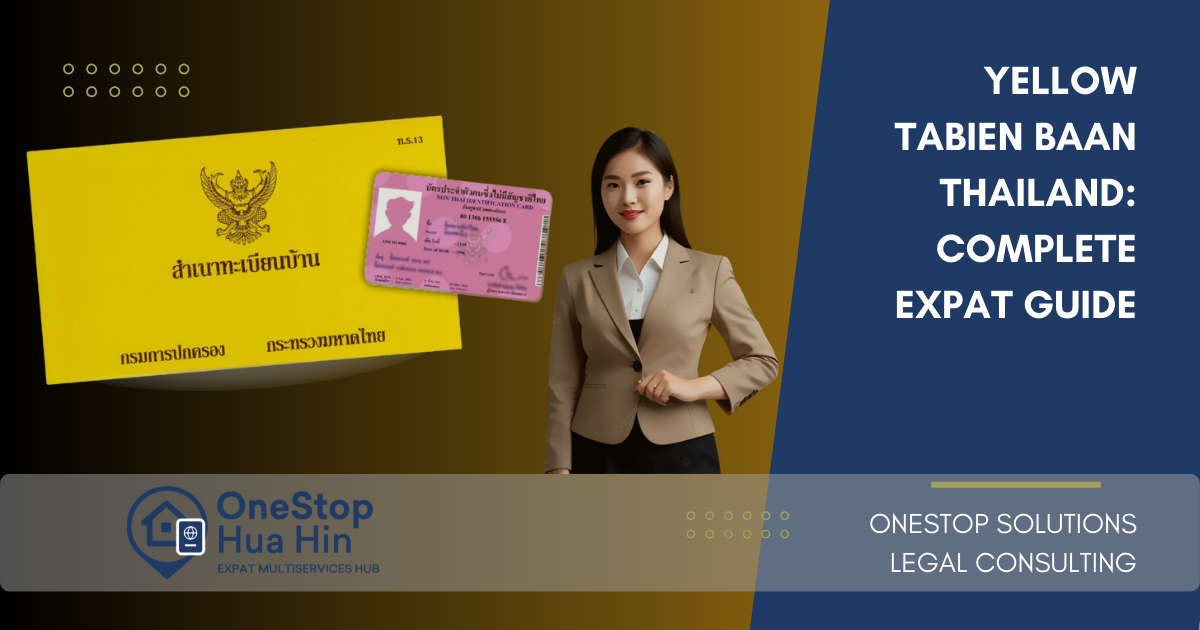
Yellow Tabien Baan Thailand: Complete Expat Guide
Yellow Tabien Baan Thailand: What Every Expat Should Know
If you are planning to live, retire, or invest in property in Thailand, you may have heard about the Yellow Tabien Baan Thailand. While it is not mandatory for every foreign resident, it can make your daily life significantly easier. Understanding how it works — and why it matters — can save you time, stress, and unnecessary bureaucracy.
At OneStop Hua Hin, we regularly assist expats with residency documentation, and the Yellow Book is one of the most misunderstood yet useful documents available to foreigners in Thailand.
Let’s break it down clearly.
What Is the Yellow Tabien Baan?
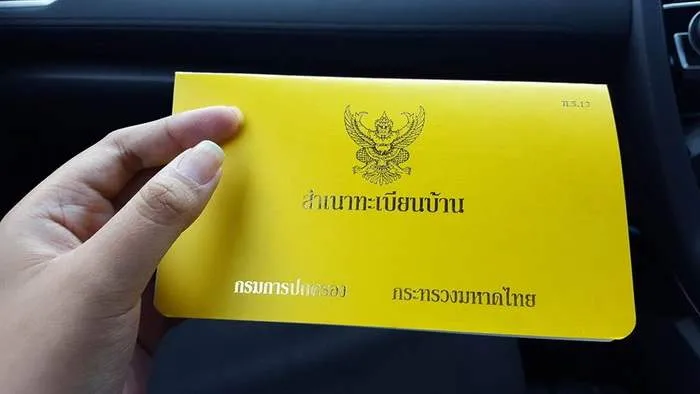
The “Tabien Baan” is Thailand’s official house registration book. It records the address where a person resides. Thai nationals are listed in a blue book, while foreigners who qualify are issued a yellow version, commonly referred to as the Yellow Book.
It is important to understand one key point:
👉 The Yellow Tabien Baan does not prove ownership of a property.
It only confirms your official residential address within Thailand’s district registration system.
Ownership is proven separately through the official land title deed (Chanote).
What Is the Yellow Tabien Baan Thailand Used For?
This is where the real value lies. The Yellow Tabien Baan Thailand is not just a book — it is a powerful administrative tool that simplifies many aspects of life for expats.
Here’s how it helps in practical, everyday situations:
1️⃣ Official Proof of Address
One of the biggest challenges for foreigners in Thailand is providing recognized proof of residence. While visa extensions or TM30 forms confirm your stay, many institutions prefer a registered house book.
The Yellow Book provides:
- Government-recognized residential confirmation
- A stable address record in the district system
- Reduced need for additional address certification letters
This can significantly reduce paperwork requests.
2️⃣ Opening a Thai Bank Account
Banks in Thailand sometimes require proof of residence beyond a rental contract. Having your name listed in the Yellow Book can:
- Speed up account approval
- Reduce additional documentation requirements
- Provide credibility as a long-term resident
While policies vary between banks, having the Yellow Book often simplifies the process.
3️⃣ Applying for or Renewing a Thai Driver’s License
When applying for a Thai driving license, authorities require proof of address. Without a Yellow Book, foreigners often need a separate residence certificate from Immigration.
With a Yellow Tabien Baan:
- You may avoid extra trips to Immigration
- Documentation becomes more straightforward
- The process is often smoother
4️⃣ Vehicle Registration
If you purchase a car or motorcycle in Thailand, you must register it under a residential address.
The Yellow Book can:
- Serve as supporting address documentation
- Help streamline the vehicle registration process
- Support ownership registration more efficiently
5️⃣ Dealing with Government Offices
When interacting with government departments — such as land offices, tax authorities, or local municipalities — having your name officially registered at an address increases administrative clarity.
It demonstrates:
- You are a recognized resident within the district
- Your address is formally recorded
- Your long-term presence is documented
This often leads to fewer verification requests.
6️⃣ Utility Services and Contracts
Setting up services like:
- Electricity
- Water supply
- Internet
- Mobile contracts
can sometimes require proof of residence. While not always mandatory, the Yellow Book can make approvals faster and easier.
7️⃣ Marriage Registration and Legal Matters
If you are married to a Thai national, the Yellow Tabien Baan can help formalize residential records. It can also assist in certain civil processes where registered address documentation is required.
8️⃣ Demonstrating Long-Term Residency Stability
While it does not grant residency status, the Yellow Book shows that you have an officially recorded address in Thailand. For retirees, investors, and property owners, this can reinforce your stability as a resident.
Who Can Apply for a Yellow Tabien Baan?
Generally, foreigners who:
- Hold a valid long-term visa
- Have legal residence in Thailand
- Can provide proof of address
- Obtain consent from the property owner (if renting)
can apply.
If you own a condominium, you may register yourself at that address. If you rent, the property owner must cooperate.
Each district office (Amphur) may interpret requirements slightly differently, so preparation is key.
Documents Typically Required
While requirements vary, you may need:
- Valid passport with current visa
- Work permit (if applicable)
- Marriage certificate (if married to a Thai national)
- House title deed or rental contract
- Thai ID copy of the property owner
- Witnesses (in some districts)
- Certified translations (if requested)
Processing time can range from same-day issuance to several weeks, depending on the district.
The Yellow Tabien Baan is issued by the local district office under Thailand’s Department of Provincial Administration (DOPA), the government authority responsible for managing the national house registration system.
What the Yellow Tabien Baan Does NOT Do
It is equally important to clarify misconceptions.
The Yellow Tabien Baan Thailand:
❌ Does NOT grant property ownership
❌ Does NOT provide permanent residency
❌ Does NOT replace your visa
❌ Does NOT override immigration regulations
It is purely a residential registration document.
Why Expats in Hua Hin Should Consider It
Hua Hin is one of Thailand’s most popular retirement and lifestyle destinations. Many long-term residents eventually realize that having their name registered locally simplifies everyday life.
If you plan to:
- Stay long-term
- Buy property
- Register a vehicle
- Open multiple service contracts
- Reduce paperwork over time
the Yellow Book becomes a practical administrative asset.
Frequently Asked Questions (FAQs)
1. Is the Yellow Tabien Baan mandatory for foreigners?
No, it is not legally required. However, it is highly useful for long-term residents.
2. Can I get it if I rent a property?
Yes, provided the landlord agrees and the district office approves the application.
3. Does it prove I own my house?
No. Ownership is proven by the official land title deed.
4. How long does the application take?
It depends on the local district office. It may take a day or several weeks.
5. Is it required for retirement visa holders?
It is not required, but many retirees obtain it to simplify administrative procedures.
6. Can it replace a residence certificate from Immigration?
In some cases, yes — especially for driver’s license applications — but requirements vary by authority.
Final Thoughts
The Yellow Tabien Baan Thailand is not just a document — it is a practical tool that helps foreign residents integrate more smoothly into Thailand’s administrative system. While it does not grant ownership or immigration privileges, it can significantly reduce bureaucracy and simplify daily transactions.
For expats in Hua Hin, having professional guidance makes the process faster and stress-free.
Need Help With Your Yellow Tabien Baan in Hua Hin?
At OneStop Hua Hin, we assist foreigners with:
✔ Document preparation
✔ District office coordination
✔ Translation and certification
✔ Full application support
📩 Contact OneStop Hua Hin today and let us handle the paperwork while you focus on enjoying life in Thailand.
